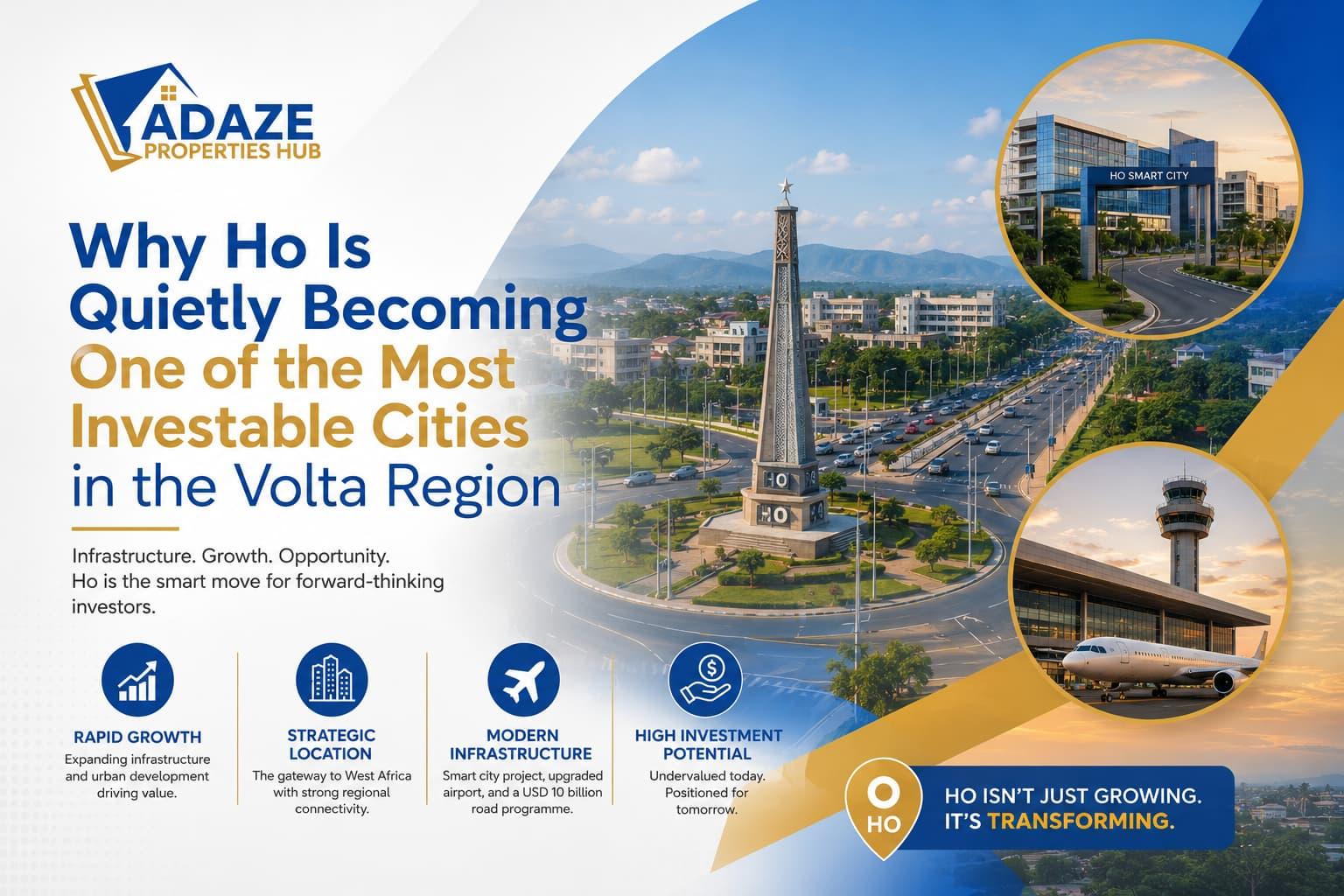
Why Ho Is Quietly Becoming One of the Most Investable Cities in the Volta Region
Key Takeaways
- •Ho is a growing regional capital with a population of around 200,000, rising faster than the national average, and strong institutional anchors including UHAS
- •The USD 10 billion Big Push programme launched in Ho in September 2025, covering major road corridors including the 117km Atimpoku to Aflao stretch, the Ho-UHAS bypass, and the Ho Guinness Depot to Airport road
- •Oxygen City, a 1,860-acre mixed-use smart city being built near Ho Airport by TDC, broke ground in December 2025 and is set to be the largest gated community in the country when complete
- •Ho Airport is being repositioned as an aviation training hub with an Airport City Precinct, with active airline interest including plans for domestic and international routes
- •Land prices in Ho have not yet fully caught up with the scale of development underway, making this a strong window for early entry investors
There is a certain kind of city that does not make noise about its growth. It does not appear on the front pages of investment magazines or dominate conversations at real estate conferences. It simply grows, steadily and deliberately, building the foundations that eventually make it impossible to ignore.
Ho is that city.
The capital of the Volta Region has been transforming quietly but meaningfully. Infrastructure is expanding. Institutions are growing. The population is rising. And in 2025, a series of landmark developments made it impossible for any serious land investor to look away. This is not speculation. This is a city with active, funded, government-backed projects already breaking ground.
A Regional Capital With Room to Grow
Ho carries the administrative weight of the Volta Region as its capital city. That status alone brings with it a concentration of government presence, public institutions, infrastructure investment, and economic activity that smaller towns simply do not have access to.
But what makes Ho particularly interesting as an investment destination is not just what it already is. It is the gap between where it currently stands and where it is clearly heading. Unlike cities that have already reached a mature stage of development and priced most investors out, Ho is still in a phase where the fundamentals are strong but the prices have not yet caught up with the trajectory.
That gap is where investment opportunity lives.
The Institutional Anchor: UHAS
No single development has done more to reshape the land and investment landscape around Ho than the University of Health and Allied Sciences. UHAS is not just a university. It is an economic catalyst.
Since its establishment, UHAS has been steadily growing its student population, expanding its faculties, and attracting academic and healthcare professionals to the region. Every person who comes to study, teach, or work at UHAS needs somewhere to live. Every family that relocates to support a student creates demand for housing, food, transport, and services.
The Vice Chancellor of UHAS has reaffirmed the university's commitment to expanding its programs, including supporting traditional medicine practitioners with training and certification, signalling that the institution's footprint in the region is only growing. The ripple effect on surrounding land values is real and ongoing. Graphic Online
The Big Push: A USD 10 Billion Infrastructure Commitment
If one development signals the seriousness of Ho's growth trajectory more than any other, it is the government's Big Push program.
In September 2025, the USD 10 billion Big Push project, aimed at comprehensively addressing the nation's infrastructure deficit, was officially launched at Titrinu, near Ho. The significance of this cannot be overstated. When a national government chooses a city as the launch point for its most ambitious infrastructure programme, it is making a public statement about where development is headed. Graphic Online
The first set of roads under the initiative covers a 117-kilometre stretch from Atimpoku in the Eastern Region through the Volta Region towns of Anyirawase, Ho, Denu and all the way to Aflao. This corridor connects Ho to major trade and border routes, fundamentally changing its position within the national road network. Graphic Online
The Big Push project also includes the 47-kilometre Ho-UHAS Bypass to Titrinu road and the 7.7-kilometre Ho Guinness Depot to Ho Airport road, two roads that directly open up the corridors surrounding Ho's most significant institutions and infrastructure. Graphic Online
Under the Big Push agenda, additional road projects captured for the Volta Region include the upgrading of the Adaklu-Tafrewaya-Anyeme road, rehabilitation of the Sokode-Juapong road, reconstruction of Have-Hohoe roads, and construction of selected roads in Ho and Hohoe municipalities. GHS 13.9 billion was allocated in the 2025 budget for the Big Push, with an additional GHS 30 billion earmarked for 2026, with funding secured to ensure timely payment to contractors. THE NEW REPUBLICTHE NEW REPUBLIC
Roads do not get built in areas governments have written off. They get built where growth is expected, planned, and funded.
Oxygen City: Ho Is Getting Its Own Smart City
Perhaps the most dramatic signal of Ho's transformation is a project that most people outside the Volta Region are only beginning to hear about.
In December 2025, President John Dramani Mahama cut the sod for the Tema Development Corporation Ho Oxygen City Community 27 Project, describing it as a landmark step in inclusive, balanced, and people-centred national development. Ghana Business News
TDC has acquired 1,860 acres of land in the Volta Region, specifically around the airport enclave in Ho. The 1,860-acre project will feature residential, industrial, commercial, health tourism and business districts supported by modern infrastructure. When completed, Oxygen City will be the biggest gated community in the country, positioned as a key pillar of the 24-hour economy. Thehighstreetjournal + 2
The facility, expected to be completed in June 2027, will include a school, hospital, a shopping mall, a gym, and a recreational centre among other amenities. allAfrica.com
Spanning 1,860 acres in Adaklu in the Volta Region, the project is designed to drive investment, tourism, and world-class regional development. This is not a housing project sitting in isolation. It is an entirely new urban district being built next to the Ho Airport, designed to attract industries along the Eastern Corridor Roads and position Ho as an emerging growth hub. GhanaWeb
Togbe Afede XIV, the Agbogbomefia of Asogli, described the project as one of the most significant developments in the history of the city and the Volta Region, noting that Ho had earned the Oxygen City accolade because of its clean environment, rich vegetation, scenic mountain ranges, and strong commitment to environmental preservation. Ghana News Agency
The Ho Airport: An Asset Whose Time Is Coming
Ho Airport was completed in 2017 and opened to commercial traffic in 2021. It has not yet reached its full potential, but the plans surrounding it are accelerating. Modern Ghana
Stakeholders are pushing a visionary initiative to transform Ho Airport into a leading aviation training and development hub, aimed at boosting the region's aviation capacity and driving tourism growth. The government's plans include upgrading the airport into a training hub, establishing certified maintenance, repairs, and overhaul systems, as well as developing an Airport City Precinct Development Scheme that would leverage private sector partnerships. GBC Ghana Ghana News Agency
Proposals include establishing flight services between Ho, Tamale, and Kumasi, alongside helicopter services connecting key tourist destinations such as the Amedzofe Mountains, Wli Waterfalls, and Afadjato Mountain. Goldstar Air has also outlined plans to position Ho Airport as a critical node in the aviation network, with round-the-clock service from Accra and Kumasi, as well as flights connecting the region to international destinations. Thebftonline Kyfilla
An airport with active investment attention, government backing, and a new smart city being built beside it is not an underperforming asset for much longer. It is a future anchor for the entire surrounding land market.
A Growing Population With Growing Needs
Ho's population is currently estimated at about 200,000 and rising faster than the national average, creating increasing pressure on housing and hospitality infrastructure. Ho has evolved into a major educational, commercial and administrative hub, hosting top-rated senior high schools, tertiary institutions, banks, and corporate offices. Ghana News Agency
This population growth is not a short-term spike. The institutions driving it are permanent. The infrastructure supporting it is expanding. And the land market will continue to reflect that reality as more people compete for well-located plots in and around the city.
The Diaspora Opportunity
Ho has a significant diaspora connection. Voltarians living abroad, across Europe, North America, and other parts of West Africa, maintain deep ties to the region and increasingly want to invest in something tangible back home.
For diaspora investors, Ho represents a combination of factors that is difficult to find elsewhere. It is a growing regional capital with strong institutional anchors, a USD 10 billion infrastructure programme actively underway, Africa's next largest gated community being built on its doorstep, and a land market that still offers genuine entry points at prices that make sense for long-term investment.
The diaspora investor who moves now, while Ho is still in this growth phase, is making a decision that their future self will find very difficult to criticise.
Why Now Is the Right Time
Every city has a window. A period where the growth is real and visible but the prices have not yet fully adjusted to reflect what is coming. That window does not stay open indefinitely.
Ho is in that window right now. The Big Push roads are breaking ground. Oxygen City is under construction. The airport is being repositioned. UHAS is expanding. The population is growing faster than the national average. What has not yet happened is the full price correction that follows when a market catches up with its own momentum.
The investors who will look back on Ho in ten years and feel the satisfaction of a well-timed decision are the ones making moves in this market today.
Build Your Legacy in a City That Is Going Places
At Adaze Properties Hub Ltd, we have been operating in the Ho land market long enough to understand its rhythms, its corridors, and its potential. We do not list land in locations we do not believe in. Every plot we bring to our clients represents our honest assessment of where value is and where it is going.
Ho is a city we believe in deeply. Its growth is not speculative. It is grounded in infrastructure, institutions, population, and government commitment at the highest level. And the land opportunities within and around it are as real as the city's trajectory.
If you are ready to invest in a city that is going places, we are ready to help you find exactly the right position within it.
Reach out to Adaze Properties Hub Ltd today. From land to legacy, we have got you.
Frequently Asked Questions
Why is Ho considered a good city for land investment in the Volta Region?
Ho is the Volta Region capital with a fast-growing population, active government infrastructure investment through the Big Push programme, a new smart city under construction near the airport, a growing university in UHAS, and a land market that still offers genuine entry points before prices fully reflect the city's trajectory.
What is the Big Push programme and how does it affect Ho?
The Big Push is a USD 10 billion national infrastructure programme officially launched in Ho in September 2025. It covers major road projects in and around the city, including the 117-kilometre Atimpoku to Aflao corridor, a Ho-UHAS bypass road, and the Ho Guinness Depot to Airport road. Roads under the programme are already under construction across the Volta Region.
What is Oxygen City and where is it being built?
Oxygen City is a 1,860-acre mixed-use development by the Tema Development Corporation, being built at Wayanu area near the Ho Airport. It will feature residential apartments, an industrial park, commercial spaces, a hospital, a school, a shopping mall, and recreational facilities. President Mahama cut the sod in December 2025 and the project is expected to be completed in 2027.
What are the plans for Ho Airport?
Ho Airport is being repositioned as an aviation training and maintenance hub, with an Airport City Precinct development planned. There are active proposals for domestic flight routes connecting Ho to Kumasi, Tamale and other cities, alongside helicopter tourism services. Goldstar Air has outlined plans to operate from the airport and connect it to the national and international aviation network.
Is Ho a good location for diaspora investors?
Yes. Ho offers diaspora investors a growing regional capital with a USD 10 billion road programme underway, a major smart city breaking ground, UHAS expansion, and a land market that still has genuine entry level opportunities. It combines strong investment fundamentals with the personal connection many Voltarians feel toward their home region.